





The Heart of Chicago Architecture
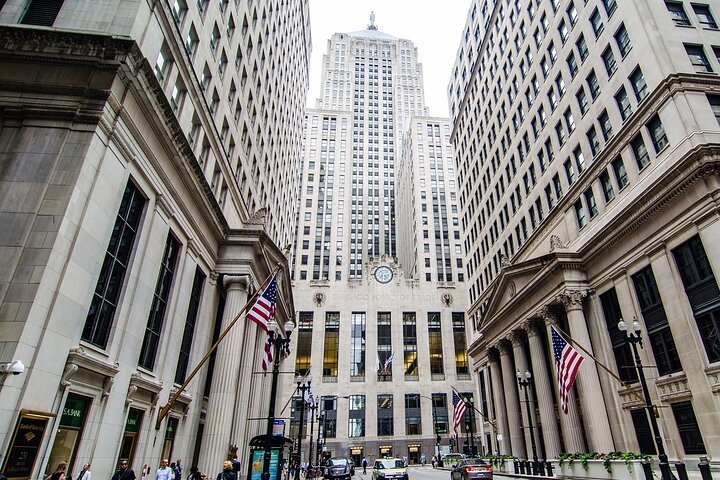
The Loop is Chicago’s central business district — a rectangle of streets bounded by the elevated train tracks (the “L”) that give the neighbourhood its name. Within this compact area (approximately 1.5 square kilometres), more architecturally significant buildings stand per block than in almost any other urban district in the world. A Loop architecture tour walks you through this concentration — from the pioneering Chicago School buildings of the 1880s and 1890s to the glass-and-steel towers of Mies van der Rohe and the contemporary additions that continue the city’s architectural dialogue.
What You Will See
The Chicago School buildings — the Rookery (1888), the Monadnock (1891), the Marquette (1895), and the Reliance Building (1895) represent the generation that invented the skyscraper. These buildings solved the engineering problems (steel frames, foundations in Chicago’s soft lakeside clay, fireproofing, elevators) that made tall buildings possible.
The Federal Center — Mies van der Rohe’s masterwork of the International Style: three steel-and-glass buildings (the Dirksen and Kluczynski buildings and the Post Office) arranged on a plaza with Alexander Calder’s “Flamingo” sculpture — a 53-foot red steel stabile that provides the visual counterpoint to Mies’s black rectilinear severity.
Millennium Park — at the Loop’s eastern edge, the park contains Frank Gehry’s Jay Pritzker Pavilion (a bandshell with deconstructivist stainless-steel panels), Anish Kapoor’s “Cloud Gate” (the Bean — a 110-ton polished steel sculpture reflecting the skyline), and the Crown Fountain (two 50-foot glass towers projecting video faces that spit water).
The Art Institute of Chicago — the museum building itself (Shepley, Rutan and Coolidge, 1893, with Renzo Piano’s Modern Wing addition, 2009) is architecturally significant, and the collection inside includes one of the finest architecture and design departments in America.
Frequently Asked Questions
How long is a Loop architecture walking tour?
Typically 2–2.5 hours covering 10–15 buildings within the Loop. The terrain is completely flat and the distances are short — the buildings are densely concentrated.
Is the Loop safe to walk?
Yes. The Loop is a busy commercial district during the day — well-policed, well-populated, and safe for visitors. Evening tours are also safe in the main Loop area.
What is the “L” and why is it called the Loop?
The “L” is Chicago’s elevated rapid transit system. The “Loop” refers to the circuit of elevated tracks that encircle the central business district — the trains loop around the rectangle of tracks, giving the neighbourhood its name.